How TaoCore Works (Math and Logic for Engineers)
This is a deep dive into TaoCore’s math and logic, written for software engineers who haven’t studied data science. The goal is not to impress you with formulas; it’s to make the system understandable, auditable, and predictable.
1. The core idea
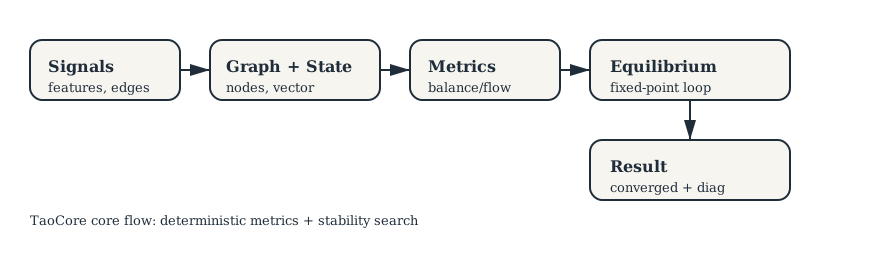
TaoCore models a system as:
- A graph of entities and relationships
- A state vector of numeric signals
- Metrics that measure structure and dynamics
- An equilibrium solver that finds stable states
If you can understand “data structures + iteration + error checking,” you can understand TaoCore.
Here is the high‑level dataflow:
2. Primitives (the data model)
Node
A node represents an entity with numeric features and optional time decay.
featuresis just a dict of numbers (e.g.,{"energy": 0.7})timestamp+decay_ratelet you compute freshness
The decay rule is exponential:
strength(t) = exp(-decay_rate * age)That gives a smooth, monotonic “freshness” factor.
Edge
An edge connects two nodes and has a weight. It can be directed or undirected. If it’s undirected, we add adjacency in both directions. This matters because centrality and clustering depend on connectivity.
Implementation note: in the code, directed=False is a first‑class flag on Edge, and Graph.add_edge mirrors adjacency when it’s false.
Graph
The graph stores:
- Nodes (by id)
- Edges
- Adjacency (neighbors)
Most graph operations are BFS-style traversal: “What’s connected?” “How far?” “Which path?”
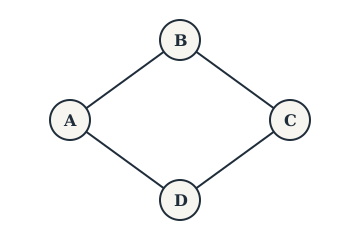
Graph sketch (undirected example):
StateVector
A StateVector is just a numeric array. It can be built from a dict or a NumPy array. Distances use Euclidean norm:
distance(a, b) = ||a - b||_2If you build from dicts, TaoCore aligns keys deterministically so distances are valid. If keys or shapes mismatch, it raises instead of silently computing a wrong distance.
3. Equilibrium solver (fixed-point iteration)
The solver repeatedly applies an update rule until the system stabilizes. This is the classic fixed‑point iteration:
x_{t+1} = f(x_t)If it converges, you have a fixed point x* where:
f(x*) = x*Why this matters: Many real systems “settle” into stable patterns. The fixed‑point method gives a principled way to find that stable state or detect that one doesn’t exist. If the sequence oscillates, TaoCore surfaces that as a failure mode instead of hiding it.
Implementation details:
- Residuals are tracked at every step.
- Convergence can require a stability window (N consecutive steps).
- Oscillation detection checks 2‑cycle and 3‑cycle patterns.
Reference: fixed‑point iteration is standard numerical analysis.
See: https://en.wikipedia.org/wiki/Fixed-point_iteration
Pseudo‑code (simplified):
state = initial
repeat:
  next = update(state)
  residual = ||next - state||
  if residual < tolerance for N steps: converged
  if oscillation detected: stop (non‑converged)
  state = next
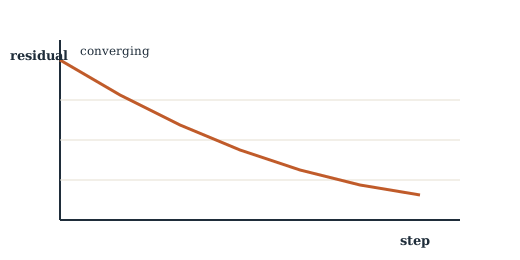
Residuals often look like this:
4. Metrics: what TaoCore measures
BalanceMetric (bounds compliance)
Given acceptable ranges, it penalizes out‑of‑bounds values:
score = 1.0                       if min <= value <= max
score = max(0, 1 - dist / range)  otherwise
This makes the logic explicit: you can see exactly why a score drops.
Example:
value = 15, bounds = [0, 10]
dist = 5, range = 10 → score = 1 - 0.5 = 0.5
FlowMetric (dynamics)
Given a sequence of states, we compute deltas:
delta_t = x_{t+1} - x_tModes:
- Coherence: are step sizes consistent?
- Volatility: how big are the steps?
- Directionality: are step directions aligned?
Directionality uses cosine similarity (range -1 to 1).
Reference: https://www.ibm.com/think/topics/cosine-similarity
Example:
delta1 = (1, 0)
delta2 = (0.5, 0)
cosine(delta1, delta2) = 1 → same direction
ClusterMetric (structure)
Three clustering strategies:
- Connected components (graph connectivity)
- Modularity (community structure)
- Distance-based (feature similarity)
Reference: https://www.baeldung.com/cs/graph-connected-components
HubMetric (centrality)
Centrality measures capture influence in the graph:
- Degree
- Betweenness
- Eigenvector
- PageRank
References:
- Degree: https://en.wikipedia.org/wiki/Centrality
- Betweenness: https://en.wikipedia.org/wiki/Betweenness_centrality
- Eigenvector: https://en.wikipedia.org/wiki/Eigenvector_centrality
- PageRank (random surfer + dangling nodes): https://en.wikipedia.org/wiki/PageRank
AttentionMetric (relevance)
Two modes:
- Similarity: cosine or Euclidean similarity between feature vectors
- Composite: weighted mix of similarity, recency, and strength
This makes the logic inspectable and tunable.
Implementation details worth noting:
- PageRank handles “dangling nodes” (no outgoing edges) by redistributing rank across all nodes.
- Attention can blend similarity, recency, and decay‑based strength into one score.
5. What TaoCore is actually doing in code
Concrete flow (minimal example):
1. Build Graph(nodes, edges)
2. Run HubMetric / ClusterMetric on the graph
3. Build StateVector from numeric features
4. Iteratively apply update_rule with EquilibriumSolver
5. Return diagnostics: convergence reason, residuals, stability score
This is the core value: the system either stabilizes with evidence, or it tells you exactly why it didn’t.
6. Equilibrium solver deep dive (with numbers)
The solver is simple but strict. It does three things every step:
- Apply the update rule:
next = f(state) - Measure residual:
||next - state|| - Decide whether to stop (converged, oscillating, or max iterations)
Example (scalar state):
f(x) = 0.8x
x0 = 10

step 0: x1 = 8.0   residual = |8.0 - 10| = 2.0
step 1: x2 = 6.4   residual = |6.4 - 8.0| = 1.6
step 2: x3 = 5.12  residual = 1.28
...
Residuals shrink geometrically → convergence.
Now a non‑converging example:
f(x) = -x
x0 = 1

step 0: x1 = -1
step 1: x2 =  1
step 2: x3 = -1
This is a 2‑cycle. TaoCore detects that pattern and returns OSCILLATION instead of pretending to converge.
Stability window:
If you require N consecutive residuals below tolerance, the solver won’t stop on a single lucky step. That prevents premature “convergence” in noisy systems.
7. Graph metrics deep dive (worked example)
Use this graph:
    B
   / \
  A   C
   \ /
    D
Edges: A‑B, B‑C, C‑D, D‑A (a diamond).
Degree centrality
Every node has degree 2. So all nodes score equally.
Betweenness centrality
Shortest paths between A and C go through B or D.
So B and D have higher betweenness than A and C.
Eigenvector centrality
All nodes are symmetric → equal eigenvector scores.
PageRank
In a symmetric graph, PageRank converges to equal scores.
In graphs with “sinks” (dangling nodes), TaoCore redistributes rank so probability mass doesn’t disappear.
ClusterMetric
Connected components → 1 cluster (fully connected by paths).
Modularity (heuristic) → likely 1 community because the graph is uniformly connected.
8. Why this is engineering‑friendly
TaoCore is designed for bounded claims:
- Deterministic metrics
- Explicit weights
- Diagnosable convergence
- Clear failure modes (oscillation, non‑convergence)
It doesn’t guess. It measures and reports.
9. Evidence in the codebase
The tests in tests/ verify:
- Graph traversal and edge cases
- Metric correctness
- Equilibrium convergence and oscillation detection
- Attention scoring and temporal decay
If you want to validate behavior, the tests are the first place to look:
tests/test_solvers.py(convergence + oscillation)tests/test_metrics.py(balance/flow/cluster/hub/composite)tests/test_attention.py(similarity + composite attention)
10. What to read next
If you want to go deeper:
src/taocore/primitives/for data structuressrc/taocore/metrics/for measurable logicsrc/taocore/solvers/equilibrium.pyfor fixed‑point iteration
I can also add a walkthrough with concrete inputs if that would help.